
Before you cut, find out what's wrong
Tree Health Assessments in Des Moines, IA
A careful look at a tree you're worried about, with a plain answer on whether to prune, treat, wait or remove.
- Free visits to quote jobs throughout Greater Des Moines and Polk County
- Separate prices for removal, stump and haul-off
- Stump and debris plans set before cutting
Is That Tree Sick, Dangerous or Just Stressed?
Tree health assessments in Des Moines answer the question homeowners actually have: should I worry about this tree? A maple dropping leaves in August, a pin oak with yellowing foliage, an old silver maple with a hollow at the base, a spruce browning from the bottom up: each could be a passing stress or the start of something serious. An assessment means looking at the whole tree, the soil around it and what it could hit, and telling you what we see in plain terms.
What we look at
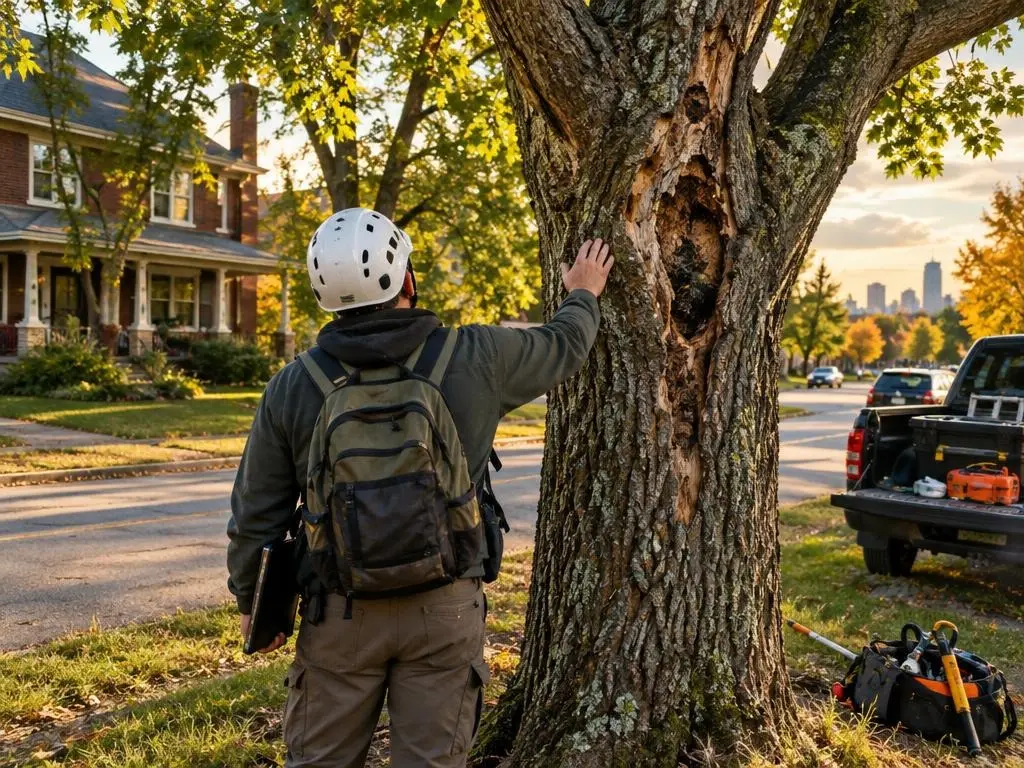
We start at the roots: soil heaving or cracking on one side, girdling roots wrapped around the trunk, fungal growth at the base, and recent digging or grade changes that may have cut roots. Then the trunk, for cavities, cracks, seams and bark that has died back. Then the branch unions, especially tight V-shaped forks with bark pinched between the stems, a common failure point in storms. Finally the crown: how much is dead, whether the leaves are the right size and color, and whether there are hangers from past storms.
Problems we see often in central Iowa
Drought is a big one: Iowa recorded 187 consecutive weeks of at least moderate drought as of January 2024, and stressed trees are more open to borers and canker diseases. Oak wilt is a major concern in Iowa; red oaks with leaves wilting and browning from the edges in early summer should be checked quickly, because the disease can spread to neighboring oaks through grafted roots. Emerald ash borer is behind most declining ash. And many trees still carry wounds and cracks from the 2020 derecho that have been rotting slowly since.
What you get
You get a walk-through with us at the tree and a clear recommendation: leave it alone, prune specific limbs, water and mulch through dry spells, treat for a specific pest, keep an eye on it and recheck in a year, or remove it. If removal is recommended, we explain why, and you are free to get a second opinion. We do not perform laboratory diagnosis; when a sample needs testing to confirm a disease, we will tell you that and where samples can be sent, such as a university plant disease clinic.
Good times to ask
The best times are before you buy a house with big trees, before building or digging near a tree, after a major storm, when a tree leafs out late or thin in spring, and when you are deciding whether a tree is worth keeping before spending money on pruning.
What an Assessment Covers
We look at the tree from the roots to the top.
Structural risk check
Cracks, cavities, weak unions, lean and root problems that raise the chance of failure.
Pest and disease signs
Emerald ash borer, oak wilt, cankers, borers and fungal decay.
Storm damage review
Hangers, split unions and old wounds checked after wind or ice.
Stress and site problems
Drought, compaction, grade changes and girdling roots.
Written recommendations
Prune, treat, monitor or remove, with reasons, on request.
Assessment Cost Guide
| Service | Published national range |
|---|---|
| General tree inspection | $75 to $150 |
| Arborist time, hourly | $75 to $200 per hour |
| Formal written tree report | up to $700 |
| Deep root fertilization, if recommended | $100 to $350 |
Figures from HomeAdvisor's arborist cost guide; some companies waive an inspection fee when you hire them for the work. Your written estimate is the price.
How an Assessment Works
1. Tell us what's bothering you
Leaves, bark, lean, a crack or a storm: describe what you've noticed.
2. Look at the tree
Roots, trunk, unions and crown inspected from the ground and up close.
3. Talk it through
We explain what we found and what each option means.
4. Plan the next step
Pruning, treatment, monitoring or removal, quoted in writing if you want it.
Why Choose Us for Tree Health Assessments
Removal is not the default
We recommend keeping a tree when it can be kept safely.
Plain language
You'll know what is wrong, how serious it is and what it costs to fix.
Tree Health Assessments Questions
Why are my oak's leaves turning brown in July?
Many things can cause it, including drought and leaf diseases, but rapid wilting and browning from the leaf edges on a red or pin oak in early summer is a classic oak wilt sign. Have it looked at quickly, and do not prune it or nearby oaks until it's diagnosed.
Can a hollow tree be safe?
Sometimes. Trees can stand for decades with some internal decay if the sound shell is thick enough and the tree isn't leaning toward a target. A large cavity, a crack or decay at the root flare changes the picture.
How do I know if a tree will fall in the next storm?
No one can predict that exactly, but some defects make failure much more likely: dead tops, cracks, tight forks with included bark, root damage and decay at the base. An assessment identifies those so you can deal with them first.
Should I water my trees in a dry year?
Yes. During drought, a slow, deep soaking under the outer half of the canopy every week or two helps, especially for trees planted in the last few years. A layer of mulch, kept away from the trunk, holds moisture in.
Tree Health Assessments Service Areas
- Tree Service in Des Moines, IA
- Tree Service in West Des Moines, IA
- Tree Service in Ankeny, IA
- Tree Service in Urbandale, IA
- Tree Service in Johnston, IA
- Tree Service in Clive, IA
- Tree Service in Waukee, IA
- Tree Service in Altoona, IA
- Tree Service in Pleasant Hill, IA
- Tree Service in Grimes, IA
- Tree Service in Norwalk, IA
- Tree Service in Windsor Heights, IA
- Tree Service in Indianola, IA
- Tree Service in Carlisle, IA
- Tree Service in Bondurant, IA
- Tree Service in Adel, IA
- Tree Service in Polk City, IA
- Tree Service in Granger, IA
- Tree Service in Mitchellville, IA
- Tree Service in Van Meter, IA
- Tree Service in Dallas Center, IA
- Tree Service in Cumming, IA
- Tree Service in Saylorville, IA
- Tree Service in Prairie City, IA