
Cuts that help the tree, not just the view
Tree Trimming & Pruning in Des Moines, IA
Deadwood out, weight off long limbs, clearance over roofs and driveways, and oaks pruned only when oak wilt can't follow the saw.
- Free visits to quote jobs throughout Greater Des Moines and Polk County
- Separate prices for removal, stump and haul-off
- Stump and debris plans set before cutting
Pruning for Wind, Ice and the Long Haul
Tree trimming and pruning in Des Moines is mostly about weight and structure. A silver maple with long, heavy limbs reaching over a roof, a linden with a tight fork in the middle, a honeylocust that hasn't been touched since the subdivision was built: each is more likely to break in a summer thunderstorm or under ice than a tree that has been shaped over time. Good pruning removes the parts most likely to fail, shortens the limbs carrying the most leverage and leaves a tree that still looks natural.
How the cuts are made
We follow the ANSI A300 pruning standard, the industry reference for tree care in the United States. That means cutting just outside the branch collar instead of flush to the trunk, avoiding stubs, and taking no more live canopy than the tree can handle in a season. It also means no topping. Cutting a tree back to stubs leaves wounds that decay and sprouts that grow fast and attach weakly, which is the opposite of what a storm-prone yard needs.
Oak wilt sets the schedule for oaks
Oak wilt is a major problem in Iowa. Sap beetles are drawn to fresh cuts and wounds and carry the fungus with them, and red oaks that get it often die within weeks of showing symptoms. The Midwest recommendation is to avoid cutting oaks from April through October, and to do oak pruning after the first hard frost or between November and April. If you call in June about an oak, we will either schedule it for the dormant season or, if a broken limb is hanging over a walkway, remove only what is unsafe and seal the cut right away.
Clearance jobs
Common clearance work around Des Moines includes lifting limbs over sidewalks and driveways so cars and snow blowers pass under them, pulling branches back from roofs and gutters, and opening space around the service line to the house. MidAmerican Energy's crews handle limbs that push, divert or wear against its lower-voltage lines, generally those under 4 inches in diameter, and the utility asks for two business days' notice before private crews work near its lines. Trees in the parking strip by the street are public trees; the city's 2020 Urban Forest Master Plan put them on a seven-year remedial pruning cycle, so call Public Works Forestry before anyone cuts one.
Young trees are the cheapest to fix
A tree planted in the last five to ten years can be steered toward one strong central leader with a few small cuts. Waiting until two competing trunks are a foot thick turns a ten-minute job into a long-term weak point. If you planted trees after losing others in the derecho, a training prune in the first few years pays off.
Kinds of Pruning
Most trimming visits combine two or three of these.
Deadwood removal
Dead and dying branches taken out before they drop on people, cars or roofs.
Crown thinning and reduction
Selected limbs removed or shortened to cut wind load and weight on long leaders.
Clearance pruning
Limbs lifted over walks and drives and pulled back from roofs, siding and service lines.
Structural pruning
Young and mid-age trees trained to one strong leader with well-spaced limbs.
Dormant oak pruning
Oak work done November through March to avoid spreading oak wilt.
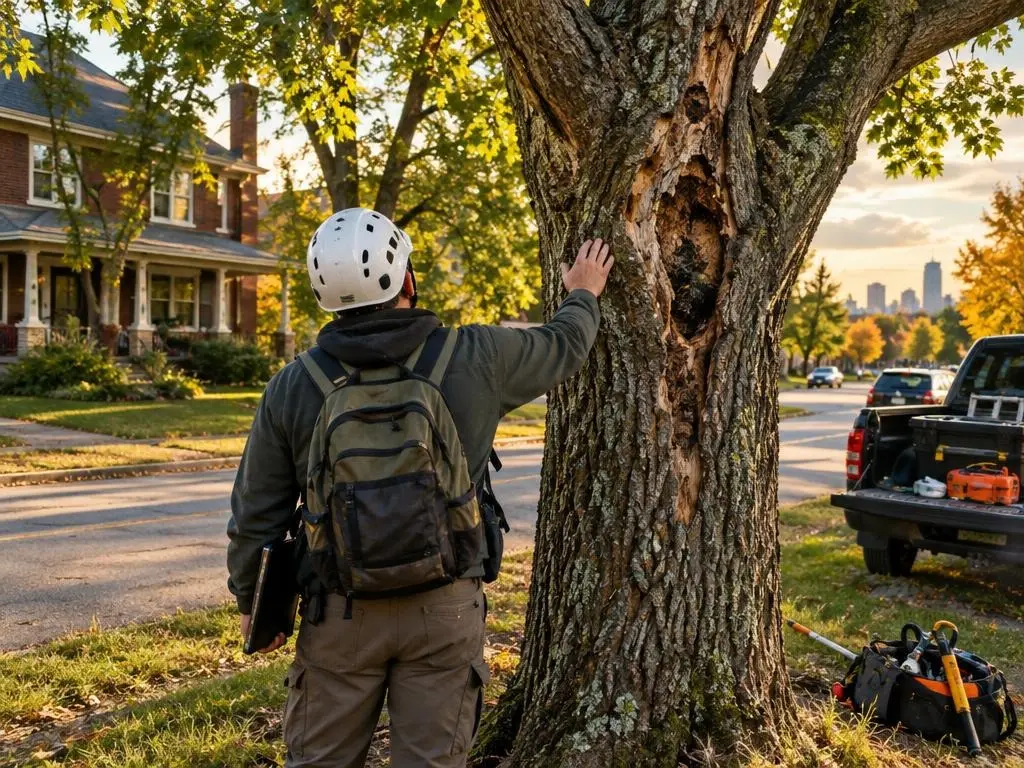
Common Tree Trimming Prices
| Tree size or job | Published national range |
|---|---|
| Tree under 30 ft | $85 to $415 |
| Tree 30 to 60 ft | $215 to $790 |
| Tree over 60 ft | $475 to $1,835 |
| Single branch removal | $50 to $175 per branch |
Size ranges from LawnStarter's 2026 tree trimming cost guide; branch removal from HomeAdvisor's tree trimming cost guide. Tight access, trees over roofs, dead wood and cleanup choices change the price. Your written estimate is the price.
How a Pruning Visit Works
1. Agree on the goal
Clearance, storm-proofing, deadwood or shaping: we confirm what you want the tree to do.
2. Mark the cuts
We show you which limbs come out and how much canopy stays.
3. Prune to standard
Cuts made at the branch collar, no topping, no climbing spikes on trees that stay.
4. Cleanup
Brush chipped and removed, lawn and gutters cleared of twigs.
Why Choose Us for Tree Trimming & Pruning
No topping
We prune to ANSI A300 practice and will explain a better option if topping is requested.
Seasonal timing
Oaks wait for the dormant season unless a limb is a hazard right now.
Tree Trimming & Pruning Questions
How often should trees be pruned?
Young trees benefit from light work every two to three years. Mature shade trees in good condition usually need attention every three to five years, or after a storm leaves broken limbs.
Can I prune my oak in the summer?
It's best not to. In the Midwest, oaks should not be cut or wounded from April through October because fresh wounds attract the beetles that spread oak wilt. Schedule oak pruning for November through March.
Will thinning really help in a storm?
Thinning and reducing long, heavy limbs lowers the leverage wind has on them and removes weak or dead wood. It doesn't make a tree storm-proof, but it reduces the chance that a big limb fails over the house.
What is topping and why don't you do it?
Topping cuts a tree's main stems back to stubs. The stubs decay and the dense new sprouts attach weakly, so the tree becomes more dangerous within a few years. Crown reduction cuts back to a side branch instead.
Tree Trimming & Pruning Service Areas
- Tree Service in Des Moines, IA
- Tree Service in West Des Moines, IA
- Tree Service in Ankeny, IA
- Tree Service in Urbandale, IA
- Tree Service in Johnston, IA
- Tree Service in Clive, IA
- Tree Service in Waukee, IA
- Tree Service in Altoona, IA
- Tree Service in Pleasant Hill, IA
- Tree Service in Grimes, IA
- Tree Service in Norwalk, IA
- Tree Service in Windsor Heights, IA
- Tree Service in Indianola, IA
- Tree Service in Carlisle, IA
- Tree Service in Bondurant, IA
- Tree Service in Adel, IA
- Tree Service in Polk City, IA
- Tree Service in Granger, IA
- Tree Service in Mitchellville, IA
- Tree Service in Van Meter, IA
- Tree Service in Dallas Center, IA
- Tree Service in Cumming, IA
- Tree Service in Saylorville, IA
- Tree Service in Prairie City, IA
Get a Tree Trimming & Pruning Estimate
Free estimates for tree trimming and pruning.